Rehabilitation
Shape and function, in one plan. From refining a smile after orthodontics to complex reconstruction.
On this page
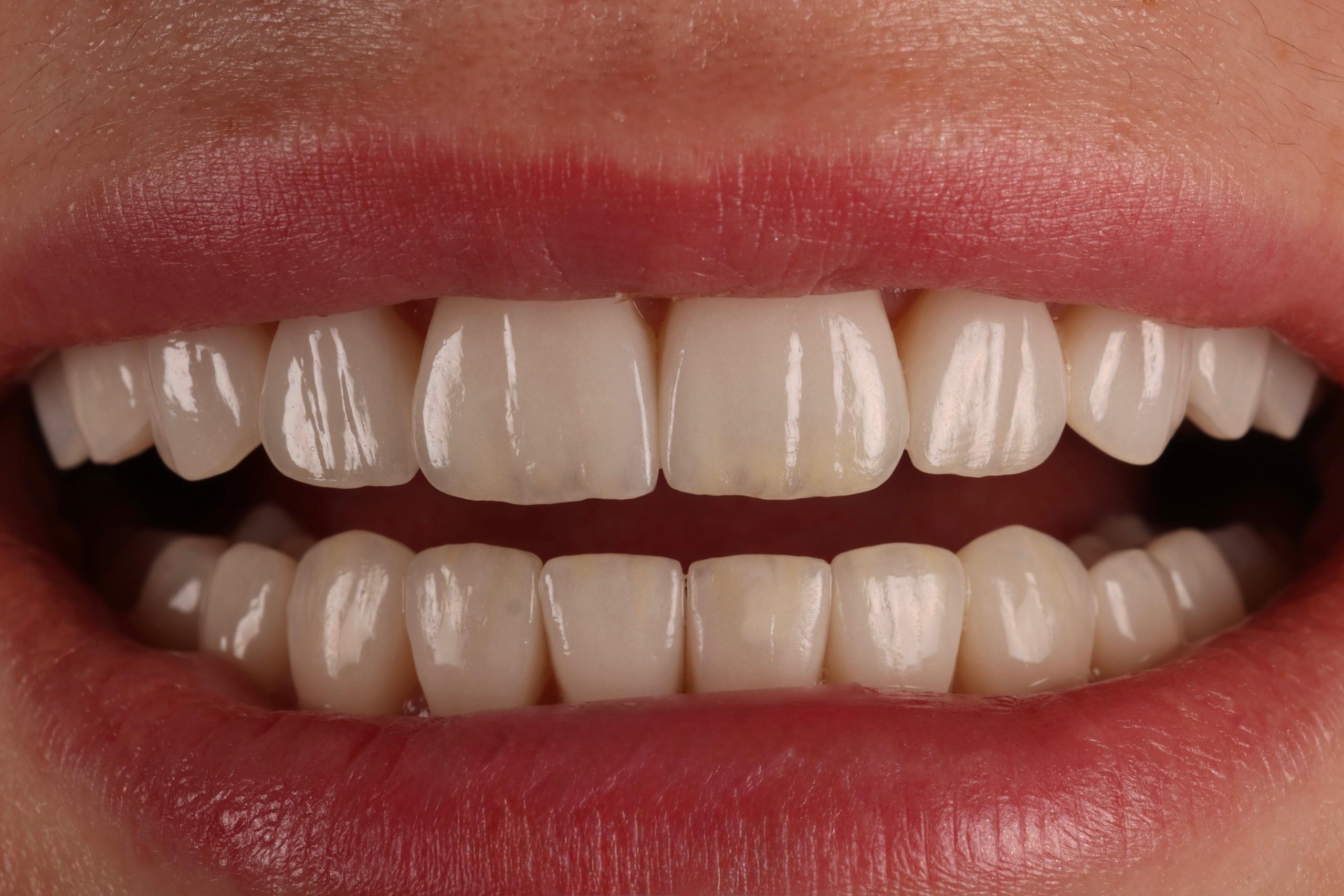
Post-orthodontic rehabilitation
Finished your braces, but the shape of your teeth, the gaps left or the way they meet are not what you expected? This page explains why that happens and what the options are.
I finished my braces, but my teeth do not meet properly. Why?
Orthodontics aligns the position of the teeth. How they meet also depends on their shape and size, and sometimes these two things do not fit together perfectly.
At the end of treatment, contacts can be few or point-like, and they can settle in the following weeks. Differences in shape (small, worn or peg-shaped teeth) are not corrected by braces. If the problem is one of position, the orthodontist can make finishing adjustments, so the first conversation should be with them. Restorations do not move teeth and do not replace orthodontic finishing.
Why do gaps remain after orthodontic treatment?
The most common causes are teeth smaller than the space available, relapse, meaning the tendency of teeth to drift back, and the anatomy of the surrounding tissues.
- Teeth smaller than the space. Small or peg-shaped lateral incisors leave gaps that braces cannot close without affecting other positions.
- Relapse. If the retainer is not worn as instructed, teeth can drift back, including the gaps.
- The labial frenum or gum tissue. Sometimes it contributes to a gap returning between the central incisors.
- A gap left on purpose. The orthodontist may leave space so the teeth can then be restored to the right proportions. This is a planning decision, not a mistake.
How residual gaps are closed
Drag the slider to add material to the small teeth. The dashed line shows the target shape set on the wax-up.
The lateral incisors are smaller than the space available, so gaps remain on both sides.
Illustration only. It does not represent a clinical result or promise an identical outcome.
A more detailed article is Why do gaps remain after braces?
How do we restore tooth shape after braces?
Most often with additive restorations, meaning we add material instead of removing enamel. There are two main options: composite applied directly to the tooth, or ceramic veneers.
The aim is correct proportions, contacts between teeth that support each other, and a shape that suits the face. The choice depends on how much has to be added, on the bite, and on whether the patient wants to keep the treatment reversible. I describe the differences on the page about veneers and bonding.
Restorative rehabilitation: stages and visits
After orthodontic treatment, tooth position may be appropriate but worn or eroded teeth, differences in shape and proportions, gaps, underdeveloped cusps or incomplete occlusal and interproximal contacts may remain.
- Planning
Tooth shape, contacts and occlusion are assessed. Photographs, intraoral scanning and a wax-up help establish the final morphology.
- Restorative rehabilitation
Teeth requiring changes are rebuilt mainly with minimally invasive adhesive composite techniques. Shape, cusps, marginal ridges, interproximal and occlusal contacts can be restored. Temporary restorations, crowns, onlays or other indirect restorations may also be included when needed.
- Completion and review
Contacts and occlusion are checked and adjusted, final photographs and scans are taken, and the retainer is remade when necessary to fit the new situation.
Adhesive procedures are carried out under isolation and, when the situation allows, with magnification.
For international patients
Predominantly restorative post-orthodontic rehabilitation may require approximately 3–4 clinical visits. In many cases, treatment can be grouped into one trip of around 4–7 days, with a subsequent review if needed. Timing depends on the patient, the number of teeth treated and case complexity.
Sources
- Magne P, Belser U. Bonded Porcelain Restorations in the Anterior Dentition: A Biomimetic Approach. Quintessence, 2002.
- Layton DM, Walton TR. An up to 16-year prospective study of 304 porcelain veneers. Int J Prosthodont, 2007.
The information on this page is general and educational. It does not replace a medical consultation, and a treatment recommendation can only be made after examining each patient. Results differ from one case to another.
Complex oral rehabilitation
Complex oral rehabilitation means restoring the function and appearance of several teeth, sometimes a whole arch, based on a diagnosis and an interdisciplinary plan.
What is tooth wear, and when does it stop being only a cosmetic issue?
Tooth wear is the progressive loss of tooth structure from causes other than decay. It becomes a medical issue when it affects function, causes sensitivity or reaches the dentine.
- Attrition comes from tooth-to-tooth contact, for example in bruxism.
- Abrasion comes from an external agent, such as forceful brushing or certain habits.
- Erosion is the dissolving of enamel by acids, from diet or from gastro-oesophageal reflux.
Tooth wear, stage by stage
Choose a stage or drag the slider. See how the teeth shorten and when dentine appears.
- Enamel
- Exposed dentine
- Original shape
The enamel is intact and the incisal edges have their natural shape.
Illustration only. The pace and degree of wear differ from person to person.
Usually the causes combine. Exposed dentine wears faster than enamel, so the process accelerates. I treat the causes before restoring teeth, because a restoration placed over an active cause will wear again. More detail in the article Tooth wear: when it stops being a cosmetic issue.
Stages of complex oral rehabilitation
Complex oral rehabilitation combines treatment of multiple teeth and different restorations to restore aesthetics, function and occlusion. Not every tooth needs the same restoration: direct composite, veneers, onlays, overlays, crowns, temporary restorations and implant-supported restorations may be combined. The aim is to choose an appropriate, conservative solution for each tooth.
- Diagnosis and planning
Consultation, photographs, scans and necessary investigations, followed by aesthetic, functional and occlusal planning.
- Restorative and provisional stage
Direct restorations, preparation for indirect restorations and provisional work may be used to test shape and the new bite.
- Definitive restorations
Definitive restorations are made after the proposed result has been validated.
- Review and maintenance
Restorations and occlusion are checked and follow-up visits are planned.
For international patients
Without orthodontic or implant treatment, complex rehabilitation may require approximately 5–7 visits, sometimes more. Treatment is generally arranged over two or more trips to allow for diagnosis, testing provisional restorations and making definitive restorations.
A complex restorative stage may require an estimated stay of 5–10 days. The exact schedule is established only after diagnosis and may change according to the clinical response and treatments needed.
Rehabilitation with orthodontics and implants
When teeth need orthodontic repositioning or missing teeth need implants, treatment is staged. It may include interdisciplinary planning, orthodontic treatment, implant or surgical procedures, healing and osseointegration, restorative and prosthetic stages, definitive restorations and maintenance.
There is no standard number of visits. Duration depends on orthodontics, the number of implants, any bone augmentation, biological healing times and the complexity of the final restoration. After diagnosis, international patients receive a personalised schedule, grouping visits in Bucharest where possible to reduce travel.
Aesthetic and functional planning
Additional planning protocols may be used in more complex aesthetic or functional cases.
Smile Pack
Depending on the case, this may include photographs and scans, impressions and planning records, a wax-up, a mock-up, provisional restorations and additional scans and records during treatment. The aim is to plan and test the aesthetic result before completing definitive restorations.
Bite Pack
When occlusion needs more extensive analysis, planning may include scans and impressions, facebow records, bite registrations, analysis of jaw relationships, a wax-up, provisional restorations and reassessment during treatment. These records help test and validate function before transferring the final situation to definitive restorations.
Sources
- Loomans B, Opdam N, Attin T, et al. Severe tooth wear: European consensus statement on management guidelines. J Adhes Dent, 2017.
- Vailati F, Belser UC. Full-mouth adhesive rehabilitation of a severely eroded dentition: the three-step technique. Eur J Esthet Dent, 2008.
The information on this page is general and educational. It does not replace a medical consultation, and a treatment recommendation can only be made after examining each patient. Results differ from one case to another.
Start with a consultation and a plan
Every treatment begins with a diagnosis: clinical examination, photographs, radiographs and, where relevant, an occlusal analysis. Only then do we discuss options.