Dental veneers in Bucharest
Veneers are thin shells of ceramic or composite bonded to the front of a tooth to change its shape, colour or proportions. This page explains when I recommend them, when I do not, and how treatment works.
On this page
What are dental veneers?
A veneer is a thin shell that covers the visible front of a tooth. It can be made of ceramic, produced in a laboratory from an impression or a scan, or of composite, sculpted directly onto the tooth in the clinic.
A ceramic veneer is bonded adhesively to enamel. Once bonded, the tooth and the veneer behave as a single structure, which is why the quality of the remaining enamel matters so much for durability. "Minimally invasive veneers" describes veneers where as much natural enamel as possible is kept.
When do I recommend veneers?
I recommend veneers when the problem is mainly shape, size or colour, the teeth have enough healthy enamel, the gums are healthy and the bite is stable.
- Small, peg-shaped or atypically shaped teeth, for example the lateral incisors.
- Worn or chipped incisal edges, within limits that leave enough enamel.
- Gaps between teeth (diastemas), when orthodontics is not wanted or not indicated.
- Discolouration that does not respond to whitening, for example after certain treatments or from intrinsic causes.
- Old, extensive restorations on visible surfaces that can no longer be redone conservatively.
- Differences in shape left after orthodontic treatment, covered on the post-orthodontic rehabilitation page.
Even in these situations I first discuss more conservative options, such as whitening, minimal reshaping or bonding.
When do I not recommend veneers?
I do not recommend veneers when they would cover a problem that needs treating first, or when a more conservative option gives the same result.
- Gum disease or active decay. We treat these first. Adhesive work on inflamed tissue is not stable.
- Bruxism without a protection plan. Repeated forces can crack ceramic or debond it. Veneers become possible only together with a night guard and a checked bite.
- Not enough enamel. Extensive wear or erosion leaves little enamel to bond to. Other types of restoration are then more suitable.
- Crowded or rotated teeth. Sometimes orthodontics corrects the position with less tooth loss than preparing for veneers.
- Expectations that veneers cannot meet. For example changing a bite or a jaw position.
- Oral hygiene that cannot be maintained. The edge of a veneer is cleaned like a tooth, and check-ups remain essential.
If your teeth are healthy and only slightly misaligned or slightly discoloured, the first option is often orthodontics or whitening. They are more conservative.
Are teeth always reduced for veneers?
No. It depends on the position of the tooth, its shape and how much the final volume has to change. I do not promise "no preparation" for every case, because not every case allows it.
A small tooth, or one sitting toward the inside, can receive a veneer with minimal or even no preparation. A bulky tooth, or one tilted outward, needs a layer of enamel removed, otherwise the veneer would look oversized.
To decide, I plan backwards: I start from the final shape, modelled on a wax-up and checked with a mock-up, and I remove only what is needed for the ceramic to fit. This way I keep enamel, which is the best surface to bond to.
How much enamel should be kept?
As much as possible, especially at the bonding margin. Bonding to enamel is more predictable than bonding to dentine.
Enamel thickness varies from tooth to tooth and within the same tooth: it is usually thicker toward the incisal edge and thinner toward the neck. Preparation is guided by a silicone key made on the wax-up, and the thickness removed is checked as I work. In minimally invasive veneers we are usually talking about a few tenths of a millimetre, but there is no single fixed value for all teeth.
How much enamel do we keep?
Move the slider and see what happens to the enamel as the preparation gets deeper. The drawing shows an upper incisor from the side.
- Enamel
- Dentine
- Pulp
- Veneer
- Exposed dentine
Minimal preparation, within the enamel. Bonding to enamel is the most predictable.
Indicative drawing, not to scale. Enamel thickness varies from tooth to tooth.
If the preparation reaches dentine over large areas, bond strength drops. In those situations I reconsider whether a veneer is still the right option.
What are a wax-up and a mock-up?
A wax-up is a model in which the final shape of the teeth is sculpted in wax or digitally, before any intervention in the mouth. A mock-up transfers that shape into the patient's mouth, using a temporary material on unprepared teeth.
A mock-up is reversible. The patient sees the shape, checks how they speak and smile with it, and I check length, midline and proportions. If something does not suit, we change the plan before any tooth is reduced. A mock-up is an approximation, not a copy of the final result, because the material and the gloss of ceramic differ.
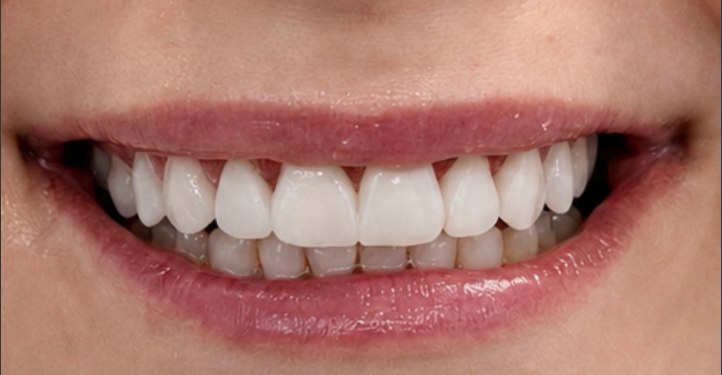
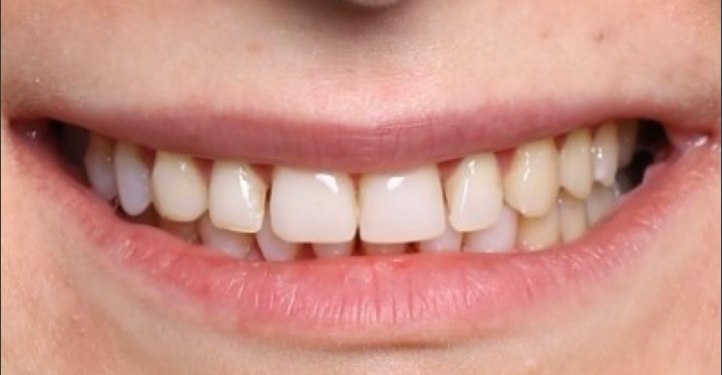 BeforeWith mock-up
I explain this in more detail in the article Wax-up and mock-up: why I do them before treatment.
How do I choose shape, colour and proportions?
I choose shape from the face, lips, smile line, age and character of the patient's teeth, not from a catalogue of standard shapes. A natural shape has small asymmetries and a surface texture that matches the neighbouring teeth.
For proportions I use reference points, for example the width to height ratio of the central incisors (the literature often quotes a range around 75 to 80%). They are guides, not rules, and the eye and the face of the patient have the last word.
Colour is chosen under controlled light, with a shade guide and photographs, and whitening, if wanted, is done before the shade is selected. I do not aim for the whitest possible result but for a shade that suits the eyes, the skin and the other teeth, within natural limits.
What role does the bite play?
The bite, meaning how the teeth meet, decides whether a veneer lasts. The incisal edge of a veneer takes force with every bite, and contacts in sideways and forward movements have to be distributed correctly.
Premature contacts, bruxism and habits such as nail biting increase the risk of cracks or debonding. That is why I check the bite before treatment, during it and at the end, and in higher-risk cases I recommend a protective night guard.
What happens if the patient has a deep bite?
In a deep bite, the upper incisors cover a large part of the lower ones vertically, and their edges strike the backs of the front teeth daily. Veneers that are lengthened in this situation are more exposed to fracture.
Before promising a change in length or shape, I check whether the bite allows it. Sometimes the answer is an edge design that avoids contact in thin areas; at other times orthodontic treatment or a different type of restoration is more suitable. There can also be situations where what the patient wants cannot be done safely.
Ceramic veneers or composite bonding?
There is no option that is better for everyone. The choice depends on how much the tooth has to change, on the forces in the bite, on aesthetic expectations and on the possibility of repairing the work later.
| Criterion | Ceramic veneers | Composite bonding |
|---|---|---|
| How it is made | In a laboratory, from an impression or scan, over several visits. | Directly in the clinic, usually in one session per area. |
| Preparation | Minimal to moderate, depending on the case. | Often minimal or none, material is added. |
| Colour stability | Very stable over time, glazed ceramic does not stain. | Can stain or lose its polish over time. |
| Wear resistance | Good. | Lower, but sufficient in many cases. |
| Repair | More difficult. A crack may mean replacing the veneer. | Easy to repair or redo. |
| Reversibility | Depends on how much structure was removed. | Higher, especially if enamel was not prepared. |
Bonding is also useful as a trial step or a temporary solution. Ceramic veneers suit cases where stability over time and precise control of shape and colour are the priority.
Veneers after braces?
Yes, they can be considered after orthodontics, but in a clear order: tooth position first, then tooth shape. Veneers do not move teeth; they change shape, size and colour.
After orthodontics there may be residual gaps, teeth smaller than the space available, or differences in shape. These situations are covered on the post-orthodontic rehabilitation page. Retention stays important and has to be taken into account in planning.
How does treatment with veneers work?
Treatment is carried out in stages, and their order matters.
- Consultation and diagnosis
Clinical and occlusal examination, photographs, radiographs, and a discussion of what the patient wants.
- Wax-up
The final shape modelled in wax or digitally, so it can be assessed before any intervention.
- Mock-up
Trying the shape in the mouth, reversibly. The plan is adjusted according to the patient's feedback.
- Preparation, if needed
With a silicone key, within the limits of the enamel, and temporary restorations if required.
- Try-in and adhesive bonding
Trying the veneers, checking colour and shape, then adhesive cementation.
- Bite check and maintenance
Adjusting contacts, hygiene instructions, a night guard if indicated, and regular check-ups.
How long do veneers last, and what are their limits?
I cannot guarantee a lifespan. Clinical studies show good long-term survival rates for ceramic veneers bonded to enamel, but the individual result depends on the bite, hygiene, habits and follow-up.
Veneers can crack, debond or develop problems at the margin, and sometimes they need replacing. If enamel has been removed, the procedure cannot be fully undone. Temporary sensitivity can occur. That is why I see veneers as a treatment that needs maintenance, not as a permanent solution.
Sources
- Layton DM, Walton TR. An up to 16-year prospective study of 304 porcelain veneers. Int J Prosthodont, 2007.
- Morimoto S, Albanesi RB, Sesma N, Agra CM, Braga MM. Main clinical outcomes of feldspathic porcelain and glass-ceramic laminate veneers: a systematic review and meta-analysis of survival and complication rates. Int J Prosthodont, 2016.
- Magne P, Belser U. Bonded Porcelain Restorations in the Anterior Dentition: A Biomimetic Approach. Quintessence, 2002.
The information on this page is general and educational. It does not replace a medical consultation, and a treatment recommendation can only be made after examining each patient. Results differ from one case to another.
Start with a consultation and a plan
Every treatment begins with a diagnosis: clinical examination, photographs, radiographs and, where relevant, an occlusal analysis. Only then do we discuss options.